
IVF Success Rate in Ahmedabad – Everything You Need to Know (2026)
Infertility affects roughly 10–15% of couples in India, and for many, In Vitro Fertilization (IVF) represents the most promising path to parenthood. If you are exploring IVF treatment in Ahmedabad, one of the first — and most important — questions you will ask is: What is the IVF success rate? This comprehensive guide answers exactly that. We break down IVF success rates in Ahmedabad by age, treatment type, and individual health factors — and show you how Nisha IVF Centre consistently delivers results that surpass national averages.
What Does ‘IVF Success Rate’ Actually Mean?
Before diving into the numbers, it is important to understand how IVF success rates are measured — because clinics may report them differently, which can create confusion.
There are three common ways IVF success is defined:
the percentage of cycles in which a pregnancy is detected by ultrasound after embryo transfer. Clinical Pregnancy Rate:
the percentage of cycles that result in a healthy baby being born. This is the most meaningful metric for patients. Live Birth Rate:
the percentage of transferred embryos that successfully implant in the uterine lining. Implantation Rate:
IVF Success Rate in Ahmedabad – Age-Wise Breakdown
Age is the single most important factor influencing IVF success. A woman’s egg quantity and quality decline naturally with age — a biological reality that directly affects fertilization, embryo quality, and implantation. Here is how success rates vary by age group at Nisha IVF Centre:
Age Group | Approximate Live Birth Rate per Cycle |
Under 35 years | 55% – 65% |
35 – 37 years | 45% – 55% |
38 – 40 years | 45% – 55% |
41 – 42 years | 25% – 35% |
43 years & above | 15% – 25% (donor eggs recommended) |
These figures align with — and in many cases exceed — data published by the Indian Society for Assisted Reproduction (ISAR) and international benchmarks from the CDC and HFEA.
If you are above 40 and concerned about your success chances, do not lose hope. At Nisha IVF Centre, we use personalised protocols including advanced embryo selection, PGT-A (Pre-implantation Genetic Testing for Aneuploidies), and donor egg IVF options to maximise your chances of a healthy pregnancy.
Key Factors That Affect IVF Success Rate in Ahmedabad
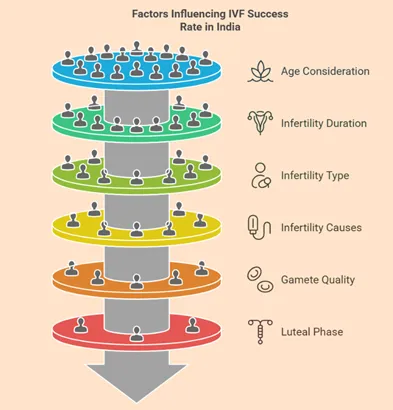
IVF success is never determined by a single factor. The following elements play a crucial role in whether a cycle results in a healthy live birth:
Woman's Age & Ovarian Reserve
As outlined above, age directly correlates with egg quality. Alongside age, we assess the ovarian reserve — a measure of how many eggs remain in the ovaries — through two tests: AMH (Anti-Mullerian Hormone) and AFC (Antral Follicle Count) via ultrasound. A good ovarian reserve significantly improves the chances of retrieving multiple high-quality eggs per cycle.
Sperm Quality & Male Factor Infertility
Male infertility accounts for 40–50% of all infertility cases. Poor sperm count, motility, or morphology can reduce fertilization rates. At Nisha IVF Centre, we perform comprehensive semen analysis for every couple. Where sperm quality is suboptimal, we use advanced techniques like ICSI (Intracytoplasmic Sperm Injection) and microfluidics-based sperm selection to identify the healthiest sperm for fertilization.
Embryo Quality & Blastocyst Culture
Higher-grade embryos have a significantly greater chance of implanting successfully. Our state-of-the-art embryology lab cultures embryos to the blastocyst stage (Day 5–6) wherever possible. Blastocysts have approximately 10–15% higher implantation rates compared to Day-3 cleavage-stage embryos.
Uterine Health & Endometrial Receptivity
Even a perfect embryo will fail to implant if the uterus is not ready. Conditions such as uterine fibroids, polyps, endometriosis, thin endometrial lining, or adhesions can prevent successful implantation. We routinely perform diagnostic hysteroscopy, ERA (Endometrial Receptivity Array) testing, and 3D uterine scans to ensure the uterine environment is optimal before embryo transfer.
Number of IVF Cycles
IVF is not always a one-cycle process. Cumulative success rates — meaning the probability of success across multiple cycles — are considerably higher than single-cycle rates. At Nisha IVF Centre, we counsel every patient on realistic expectations and long-term strategy rather than focusing only on a single attempt.
Lifestyle Factors
Obesity, smoking, excessive alcohol consumption, extreme stress, and nutritional deficiencies can all negatively affect IVF outcomes. Our team provides dedicated lifestyle counselling and a customised diet plan before treatment begins, as even small improvements in lifestyle can meaningfully impact success rates.
Quality of the IVF Laboratory
This is perhaps the most underrated factor. The IVF laboratory environment — temperature, air quality, humidity, CO2 levels, and media quality — directly determines how embryos develop. Nisha IVF Centre operates a fully-equipped, HEPA-filtered IVF lab with time-lapse incubator technology that monitors embryo development continuously without disturbing them.
IVF Success Rate by Treatment Type at Nisha IVF Centre
Different fertility treatments carry different success rates. Here is a comparative overview of what patients can expect at Nisha IVF Centre, Ahmedabad:
Treatment | Approximate Cost (INR) | Success Rate |
IUI (Intrauterine Insemination) | ₹5,000 – ₹15,000 | 10% – 20% per cycle |
Conventional IVF | ₹80,000 – ₹1,50,000 | 45% – 60% per cycle |
IVF with ICSI | ₹1,00,000 – ₹1,70,000 | 50% – 65% per cycle |
Frozen Embryo Transfer (FET) | From ₹45,000 | 45% – 55% per cycle |
IVF with Donor Eggs | ₹1,00,000 – ₹1,50,000 | 60% – 75% per cycle |
IVF with PGT-A (Genetic Screening) | Additional ₹40,000+ | Up to 70% per transfer |
Mini IVF (Mild Stimulation) | ₹60,000 – ₹1,00,000 | 30% – 45% per cycle |
Nisha IVF Centre vs. National Average IVF Success Rate
Benchmark | Success Rate (under 35) | Rating |
National Average (India) | 30% – 40% | Variable |
Ahmedabad City Average | 35% – 45% | Good |
Nisha IVF Centre | 55% – 65%* | Excellent |
International Benchmark (UK) | 33% – 40% | Good |
International Benchmark (US) | 40% – 50% | Very Good |
Why Nisha IVF Centre Consistently Outperforms Averages
- Personalised ovarian stimulation protocols — no ‘one-size-fits-all’ approach
- Blastocyst culture to Day 5/6 for superior embryo selection
- Time-lapse incubator technology for undisturbed embryo monitoring
- ERA (Endometrial Receptivity Array) testing for optimal transfer timing
- PGT-A for patients with recurrent failure or advanced age
- Comprehensive pre-cycle workup — no couple starts treatment without a full diagnosis
- Dedicated patient counselling and emotional support throughout the journey
Cumulative IVF Success Rate – Why Multiple Cycles Matter
A single IVF cycle gives you a certain probability of success. But what if you consider multiple attempts? Cumulative success rates across 2–3 cycles are substantially higher — which is why it is important not to lose hope if your first cycle does not succeed.
Number of Cycles (Women under 35) | Cumulative Live Birth Probability |
After 1 IVF cycle | 55% – 65% |
After 2 IVF cycles | 75% – 80% |
After 3 IVF cycles | 85% – 90% |
At Nisha IVF Centre, we review every failed cycle thoroughly. We examine embryo development reports, endometrial response, hormonal profiles, and immunological factors to understand why a cycle did not succeed — and modify the protocol accordingly. Many patients who had failed IVF at other centres have achieved successful pregnancies at our clinic through this approach.
How Nisha IVF Centre Maximises Your IVF Success Rate
Our approach to improving IVF success rates is built on eight pillars of excellence:
Before a single injection is given, every patient undergoes a full fertility workup including hormone profiling (FSH, LH, AMH, TSH, prolactin), transvaginal ultrasound, hysteroscopy, semen analysis, and genetic screening where appropriate. Comprehensive Pre-Cycle Diagnosis:
We do not use a standard stimulation protocol for all patients. Poor responders, high responders, and PCOS patients each receive a protocol tailored to their specific ovarian profile. This reduces the risk of cycle cancellation and OHSS (Ovarian Hyperstimulation Syndrome). Individualised Stimulation Protocols:
We use microfluidic chip technology and IMSI (Intracytoplasmic Morphologically-selected Sperm Injection) for male factor cases, selecting only the most morphologically normal and DNA-intact sperm for fertilization. Advanced Sperm Selection:
Embryos are cultured to the blastocyst stage wherever possible and cryopreserved using vitrification — a rapid-freeze technique that gives frozen embryos a survival rate of over 95%. Blastocyst Culture & Vitrification:
For patients with recurrent implantation failure, ERA testing identifies the precise ‘window of implantation’ — the optimal moment when the endometrium is most receptive — ensuring embryo transfer is performed at exactly the right time. ERA Testing:
Pre-implantation Genetic Testing allows us to screen embryos for chromosomal abnormalities (PGT-A) or specific genetic mutations (PGT-M) before transfer, dramatically improving implantation rates and reducing miscarriage risk. PGT-A / PGT-M:
Careful hormonal support after embryo transfer is critical. We monitor every patient’s progesterone and oestrogen levels post-transfer and adjust medications as needed. Luteal Phase Support:
The psychological burden of IVF is real. Nisha IVF Centre offers dedicated counselling sessions for patients and couples throughout the treatment journey, recognising that emotional wellbeing directly influences treatment adherence and outcomes. Emotional & Psychological Support:
Why Choose Nisha IVF Centre for IVF Treatment in Ahmedabad?
With dozens of fertility clinics in Ahmedabad, choosing the right one is a critical decision. Here is what sets Nisha IVF Centre apart:
Parameter | Nisha IVF Centre |
Lead Specialist | Dr. Nisarg Patel – 13+ years, 8,000+ IVF cycles, Gujarat Pioneers 2020 Award |
Lab Technology | Time-lapse incubators, HEPA filtration, vitrification, ERA testing |
Success Rate (under 35) | 55–65% per cycle — above national average |
Treatment Range | IVF, ICSI, IUI, FET, PGT, Egg Freezing, TESA/PESA, Donor Egg |
Patient Support | Full-time counsellors, online consultations, 24×7 helpline |
Transparency | Written treatment plans, no hidden costs, transparent pricing |
Network | 10+ IVF centres across Gujarat, Rajasthan & Nepal |
Frequently Asked Questions
Q: What is the IVF success rate in Ahmedabad?
IVF success rates in Ahmedabad range from 35–50% on average across clinics. At Nisha IVF Centre, the live birth rate for women under 35 is 55–65% per cycle — significantly above the national average.
Q: Does age affect IVF success rates?
Yes. Age is the single most significant factor. Women under 35 have the highest success rates (55–65%), while rates decline to 25–35% for women in their early 40s. Donor egg IVF can maintain success rates of 60–75% regardless of age.
Q: How many IVF cycles does it take to get pregnant?
Most successful pregnancies at Nisha IVF Centre occur within 1–3 cycles. Cumulative success rates across three cycles can reach 85–90% for women under 35. Each failed cycle is reviewed and protocols are adjusted for the next attempt.
Q: What is the difference between IVF and ICSI success rates?
Conventional IVF allows eggs and sperm to fertilise naturally in the lab. ICSI involves injecting a single sperm directly into each egg — recommended for male factor infertility. ICSI typically achieves slightly higher fertilisation rates (70–80%) compared to conventional IVF (60–70%), translating to marginally better overall success rates.
Q: How do I check the IVF success rate of a clinic in India?
Ask the clinic for their live birth rate (not just positive pregnancy test rate), broken down by age group. Verify whether they accept all patients or only easy cases. Check patient reviews on Google, Practo, and Justdial. Memberships in ISAR (Indian Society for Assisted Reproduction) are a mark of professional credibility.