
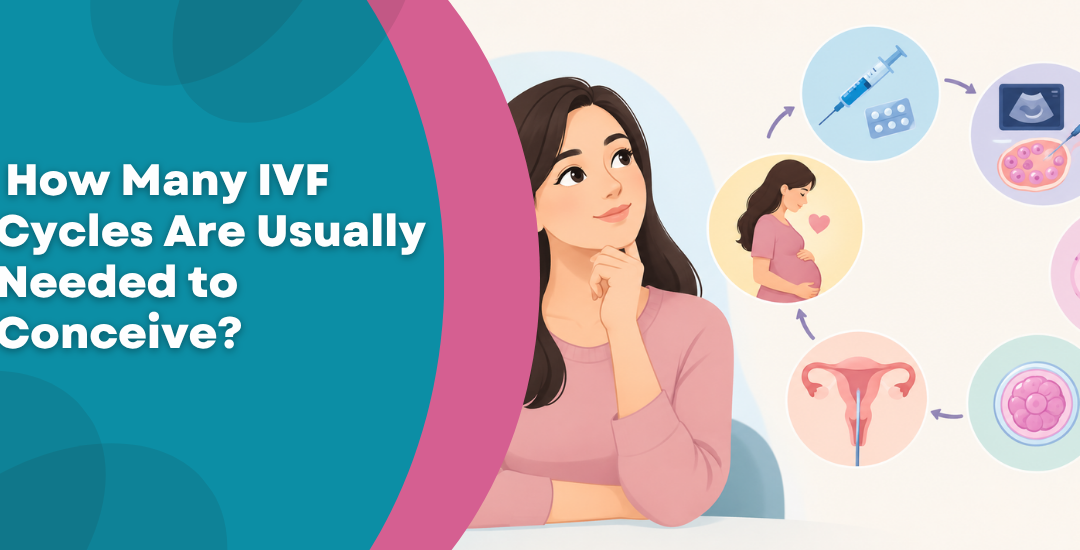
Most people need 2 to 3 IVF cycles to achieve a successful pregnancy, though some conceive on their first attempt. That’s the honest, unglamorous answer, and if you’re just starting this process, it’s probably not what you were hoping to hear. Nobody wants to plan for “maybe the third try.” But knowing this upfront tends to help more than it hurts, because it resets expectations before disappointment has a chance to set in.
The real answer, of course, is more personal than a single number. How many cycles you’ll actually need depends on your age, your ovarian reserve, the quality of the embryos your body produces, and what’s causing the infertility in the first place. Two people can walk into the same clinic with completely different odds
According to Dr. Nisarg Patel of Nisha IVF, an expert in IVF Centre in Ahmedabad, “Patients often ask us for a single number, and we understand why. Uncertainty is exhausting. But we’d rather give an honest range based on your specific case than a comforting number that doesn’t hold up. What we can tell you is that the odds of success go up with each additional cycle, up to a point, and that most of our patients who don’t conceive in cycle one do conceive within the next two.”
Want a personalized estimate based on your own case?
What Actually Decides How Many Cycles You'll Need
There’s no single dial that controls this. A few things tend to matter more than the rest.
Age. This is the biggest factor by a wide margin. Younger patients generally see higher success rates per cycle, which means fewer cycles needed overall. As age increases, particularly past the mid-to-late 30s, both egg quantity and quality decline, and more cycles are often needed to reach the same outcome.
Ovarian reserve. How many eggs your body can produce in a stimulated cycle directly affects how many usable embryos you get. A lower reserve doesn’t mean IVF won’t work. It usually just means the path takes a bit longer.
Underlying cause of infertility. Male factor infertility, unexplained infertility, endometriosis, and blocked tubes don’t all respond to IVF the same way. Some conditions respond very well to a single well-planned cycle; others take more troubleshooting.
Embryo quality. Even with a good number of eggs retrieved, not every embryo will be viable for transfer. This is one of the reasons two patients with similar profiles can still have very different cycle counts.
If cost is part of what’s weighing on you as you think through multiple cycles, our detailed 2026 IVF cost guide for Ahmedabad breaks down what each additional cycle typically adds to the total.
Does the Chance of Success Really Go Up With Each Cycle?
Yes, for most patients, up to a point. This is one of the more reassuring things research on this topic shows: the cumulative chance of a live birth increases with each additional cycle, particularly through the first three to four attempts. It’s not that any single cycle becomes more likely to work on its own. It’s that trying multiple times gives your body more chances, and each failed cycle often gives your fertility team more information to refine the next one, whether that means adjusting medication doses, timing, or the transfer protocol based on what happened before.
That said, this isn’t unlimited. For patients over 42, or after several unsuccessful attempts, the added benefit of yet another cycle starts to plateau, and that’s usually the point where your doctor will want to have a more detailed conversation with you about next steps.
Our IVF treatment program at Nisha IVF Centre reviews each cycle’s outcome with you in detail before deciding whether, and how, to proceed to the next one.
Why Couples Choose Nisha IVF for This Journey?
Dr. Nisarg Patel of Nisha IVF Centre understands that going through more than one IVF cycle is emotionally taxing in a way that’s hard to explain to someone who hasn’t been through it. He and the team at Nisha IVF Centre have supported hundreds of couples across Ahmedabad through exactly this, including the ones who didn’t succeed on the first or even second try. Every cycle here is reviewed by the full team, not just one doctor’s read of the results, so that if a second or third attempt is needed, it’s genuinely informed by what happened before, not just a repeat of the same plan.
That matters because repeating a cycle without adjusting anything rarely changes the outcome. What you deserve is a plan that evolves with you.
Call 9081233800 to book your consultation.
FAQs
How many IVF cycles do most people need to get pregnant?
Most people need 2 to 3 cycles, though some conceive on their first attempt.
Does the chance of success increase with more IVF cycles?
Generally yes, up through the first three to four cycles, after which the added benefit tends to level off, especially for women over 40.
At what point should you consider stopping IVF cycles?
This is a personal and medical decision, usually made in consultation with your doctor after multiple unsuccessful cycles, factoring in age, ovarian response, and emotional and financial capacity.
Does age affect how many IVF cycles you'll need?
Yes, significantly. Younger patients typically need fewer cycles due to higher per-cycle success rates, while patients over 35 to 40 often need more.
Refrence
Khalife D, et al. Cumulative Live-Birth Rates by Maternal Age after One or Multiple In Vitro Fertilization Cycles. Int J Fertil Steril. 2020. PMC (NIH): https://pmc.ncbi.nlm.nih.gov/articles/PMC7139227
Cumulative Live-Birth Rate After In Vitro Fertilization. N Engl J Med via PMC (NIH): https://pmc.ncbi.nlm.nih.gov/articles/PMC3623697
Disclaimer:
This content is published for educational and informational purposes only.