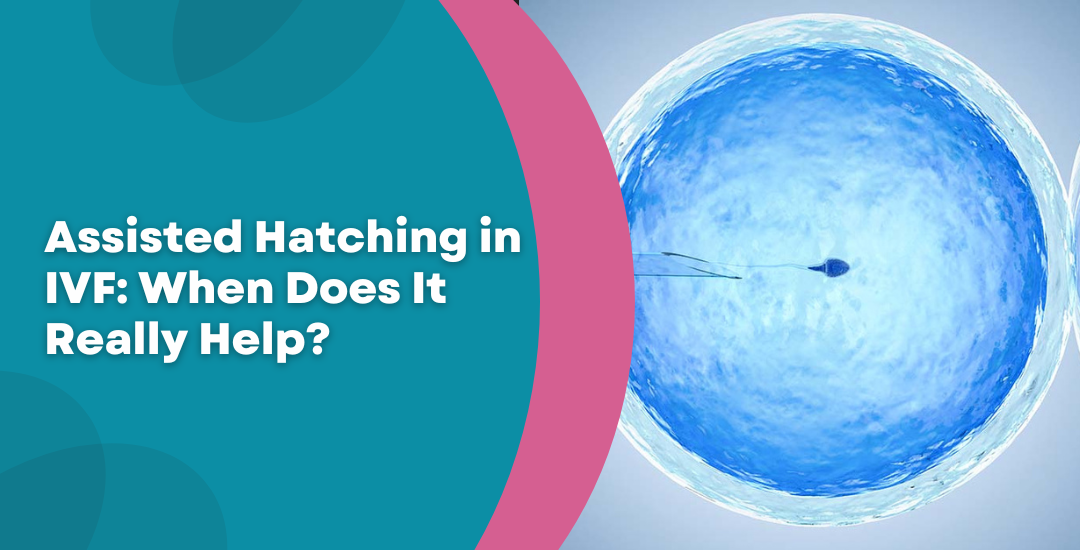
Assisted hatching is one of those add-on procedures that gets asked about a lot, and the honest answer is: it depends entirely on who’s asking. It’s a lab step where an embryologist makes a tiny opening in the embryo’s outer shell, the zona pellucida, right before transfer, so the embryo has an easier time breaking out and implanting. For a 32-year-old with a great-looking embryo, it probably won’t move the needle. For someone in their late 30s doing a frozen transfer after two failed cycles, it might actually be the missing piece.
Dr. Nisarg Patel of Nisha IVF Centre puts it simply: we don’t add assisted hatching to a cycle just because we can. It’s there for embryos that genuinely need help getting out of the shell not as something we tack onto every transfer by default.
Wondering if assisted hatching is right for your IVF cycle?
Who actually benefits from assisted hatching?
Research on assisted hatching has gone back and forth for years, and a lot of that confusion comes from lumping every patient together. Split the data by who’s being treated, and a clearer picture shows up.
Candidate profile | Why assisted hatching helps |
Female age above 37-38 | The zona pellucida naturally thickens with age |
Frozen-thawed embryo transfers | Freezing can toughen the shell further |
Two or more previous failed IVF cycles | May point to a hatching-related implantation problem |
Thick or unusual zona spotted under the scope | Something the embryologist can flag visually |
Elevated FSH or low ovarian reserve | Often shows up alongside zona changes |
Age changes the shell, not just the eggs. Past a certain point, the zona pellucida tends to thicken and stiffen, which can genuinely make it harder for an otherwise healthy embryo to break free and implant on its own.
Frozen embryos face an extra hurdle. The freeze-thaw process can toughen the outer shell a bit more, which is part of why clinics lean toward assisted hatching more readily in frozen cycles than fresh ones.
Repeated failures aren’t always about the embryo itself. When implantation has failed more than once despite good grading, it’s worth checking whether the shell was the actual obstacle rather than assuming the embryo was at fault.
For patients going through frozen embryo transfer, our embryology team assesses zona thickness at thaw and decides on assisted hatching case by case, not as a routine step.
When does it not help or even add risk?
This is the part that gets skipped in a lot of conversations. Assisted hatching isn’t harmless just because it’s minor used on the wrong embryo, it can do more harm than good.
Younger patients with high-quality embryos. Under 35, with embryos grading well and no history of failed transfers, most data doesn’t show a meaningful benefit. These embryos are usually capable of hatching on their own.
There’s a real, if small, risk of damage. The procedure involves opening the shell mechanically, chemically, or with a laser, and doing that on an embryo that didn’t need it carries a small chance of harming cells in the process.
A slightly higher twinning risk. Some studies have linked assisted hatching to a higher chance of identical twins, which comes with its own pregnancy considerations worth discussing beforehand.
It won’t fix poor embryo quality. If embryos are grading poorly to begin with, opening the shell doesn’t change what’s inside. In these cases, addressing the actual issue sometimes through pre-implantation genetic testing to select the healthiest embryo matters more than the hatching step itself.
We’ve covered the technical side of how this is performed at the blastocyst stage in our post on hatched blastocyst on day 5. It is a precision tool for specific situations, not a general success booster.
Why Choose Dr. Nisarg Patel?
Dr. Nisarg Patel is an MBBS and MS in Obstetrics and Gynaecology, with Fellowships in Infertility, IVF, and Obstetric Ultrasound, and a Diploma in Advanced Gynaec Endoscopy. He has performed over 8,000 IVF cycles across more than 10 years of practice, and applies embryology techniques like assisted hatching, blastocyst culture, and PGT only where the case genuinely calls for them, rather than as a routine part of every cycle. He’s a “Gujarat Pioneers 2020” awardee, practising across Gujarat, Rajasthan, and Nepal.
FAQ
Is assisted hatching something every IVF patient should ask for?
Not really. It tends to help specific groups like older patients, frozen transfers, people with prior failed cycles more than the average patient, so it’s not applied across the board.
If I do assisted hatching, does that mean the embryo will implant?
No, it just makes hatching easier. Whether implantation follows still comes down to the embryo itself and the uterine environment at the time.
Could assisted hatching actually hurt the embryo?
There’s a small risk, mainly when it’s done on an embryo that didn’t really need it, which is why case selection gets so much attention before it’s recommended.
Does it raise the odds of having twins?
A few studies point to a slightly higher chance of identical twins with assisted hatching, and it’s usually discussed with patients before the procedure.
Reference
- NCBI – Assisted Hatching Does Not Enhance IVF Success in Good-Prognosis Patients a controlled study comparing implantation and pregnancy rates with and without assisted hatching in young, good-prognosis IVF patients.
- PMC – Unlocking the Potential of Assisted Hatching in Assisted Reproductive Technology: A Narrative Review covers mechanical and chemical assisted hatching techniques and implantation outcomes across different patient groups.
Disclaimer
This article is for informational purposes only and is not a substitute for professional medical advice please consult a qualified fertility specialist before making any treatment decisions.