
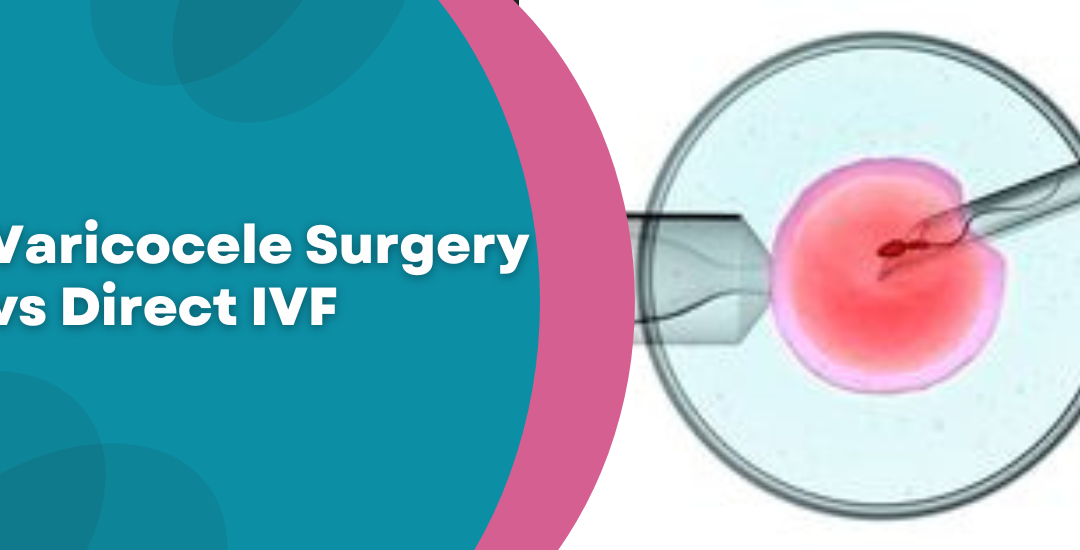
Varicocele surgery (varicocelectomy) is the preferred first-line treatment when sperm parameters are mildly to moderately affected, the male partner is young, and the female partner has no fertility issues, with sperm improvement seen in 60 to 70 percent of cases within 3 to 6 months. Direct IVF or ICSI becomes the better path when varicocele coexists with severe oligospermia, azoospermia, advanced maternal age, or female factor infertility, because waiting for surgical recovery wastes ovarian reserve time. The decision depends on semen analysis severity, female age, and how much reproductive runway the couple has left.
According to Dr. Nisarg Patel, male infertility treatment,Varicocele repair makes sense when the male partner is young and the female side is clear, but past 35 on the female side, IVF saves time that surgery would burn through.
Stuck between fixing the varicocele first or going straight to IVF?
When does varicocele surgery work better than going directly to IVF?
Surgery wins on selection. Pick the right candidate and the natural conception odds genuinely climb. Pick wrong, and months get lost for nothing.
Indication | Why surgery is preferred |
Palpable grade 2 or 3 varicocele | Clear anatomical cause of sperm impairment |
Sperm count above 5 million/mL | Enough baseline to improve meaningfully |
Female partner under 35 | Time window allows 6 to 12 month wait |
Normal female workup | No competing fertility factors |
Pain or testicular atrophy | Surgical indication beyond fertility |
Sperm parameters. Studies show varicocelectomy improves sperm count, motility, and morphology in around 60 to 70 percent of operated men. Not every case, but enough to make it worth trying first.
Recovery timeline. Microsurgical varicocele repair takes about 45 minutes under anaesthesia, with patients walking out the same day or the next. Semen analysis is repeated at 3 and 6 months to track actual improvement.
Natural conception rates. Around 30 to 45 percent of couples conceive naturally within 12 months of successful repair, which works out cheaper and less invasive than running multiple IVF cycles.
DNA fragmentation. This one matters quietly. Varicocele raises sperm DNA damage, and surgical correction brings DNA fragmentation index down, which sometimes helps couples who had unexplained IVF failures earlier.
So when the female partner is young and the male side has a fixable structural problem, surgery usually pays off. For couples already exploring next steps, ICSI treatment becomes the fallback only if post-surgical sperm parameters still don’t recover.
When should couples skip surgery and move straight to IVF or ICSI?
There’s a point past which surgery just delays the inevitable. Knowing where that point sits matters more than the surgery debate itself.
Severe oligospermia or azoospermia. Sperm count under 1 million/mL or no sperm in ejaculate at all. Surgery here gives improvement in only 20 to 30 percent of cases, and ICSI works regardless because even a single retrieved sperm is enough.
Female partner over 35. Every month of waiting drops her ovarian reserve. A 6-month wait for surgical improvement at her age can mean a real shift in IVF success odds afterward. Not a tradeoff worth making.
Combined male and female factors. Tubal blockage, low AMH, endometriosis, or PCOS on the female side plus varicocele on the male side. IVF tackles both sides in one cycle.
Failed prior varicocele surgery. Sperm parameters haven’t improved 9 months post-op, or pregnancy hasn’t happened in a year. Time to pivot, and ICSI is the standard next step.
When sperm retrieval becomes necessary in non-obstructive azoospermia cases, surgical retrieval methods like TESA, PESA, and TESE get paired with ICSI to make pregnancy possible. The decision tree isn’t surgery versus IVF in isolation. It’s about which gives the couple their best shot in the shortest realistic window.
Why Choose Dr. Nisarg Patel?
Dr. Nisarg Patel is an MBBS and MS Obstetrics and Gynaecology, with Fellowships in Infertility, IVF, and Obstetric Ultrasound, plus a Diploma in Advanced Gynaec Endoscopy. Over 10 years of clinical work and more than 8,000 IVF cycles handled, including complex male factor cases involving varicocele, azoospermia, and surgical sperm retrieval. He’s a “Gujarat Pioneers 2020” awardee and an experienced IVF specialist practising across Gujarat, Rajasthan, and Nepal.
FAQ
Does varicocele always need surgery?
No, surgery is needed only when fertility is affected or symptoms exist.
Can IVF work without fixing varicocele first?
Yes, IVF and ICSI work regardless of varicocele status in most cases.
How long after varicocele surgery to expect sperm improvement?
Sperm parameters usually improve within 3 to 6 months post-surgery.
Is ICSI better than varicocele surgery?
ICSI is better when sperm count is very low or female age is advanced.