Polycystic Ovary Syndrome (PCOS) is one of the most common hormonal disorders affecting women of reproductive age. This can be really frustrating for women who want to have a baby. Now because of new fertility treatments women with PCOS have more chances to get pregnant. For example, they can try In Vitro Fertilization or IVF Treatment for PCOS. This is really news for women with PCOS who want to be mothers. PCOS is still a challenge. Women, with PCOS do not have to give up on their dreams of having a family.
In this blog, we’ll explore how IVF can help women with PCOS, and why Nisha IVF is a trusted partner in turning your parenthood dreams into reality.

How PCOS Affects Fertility

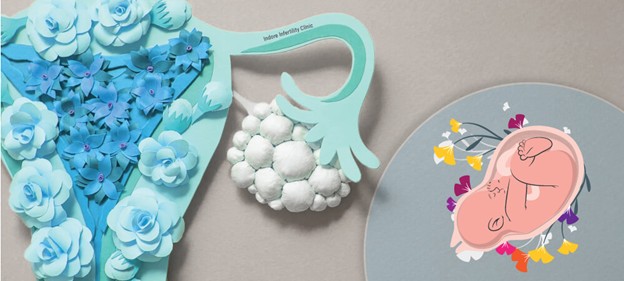
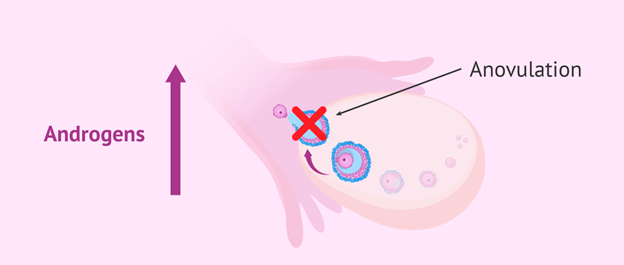
PCOS is characterized by hormonal imbalances that can interfere with normal ovulation. Women with PCOS may experience irregular periods, excess androgen levels, and cysts in the ovaries. These factors can make it harder for a woman to get pregnant naturally. Here’s how PCOS affects fertility:
E

Irregular Ovulation:

In PCOS, the ovaries may fail to release eggs regularly, resulting in infrequent or absent ovulation. Without ovulation, it’s impossible to conceive.
E

Hormonal Imbalances

High levels of male hormones like testosterone can prevent the ovaries from releasing eggs. These hormonal imbalances can also cause symptoms like acne and excessive hair growth.
E

Cysts in the Ovaries

While cysts themselves don’t usually cause harm, their presence can disrupt normal hormonal regulation, further affecting ovulation.
Women with Polycystic Ovary Syndrome or PCOS can still have babies. PCOS does not mean they cannot get pregnant. Many women who have PCOS are able to get pregnant with the help and care. For women, with PCOS In Vitro Fertilization or IVF is often a way to get pregnant. IVF helps women with PCOS because it can fix problems with ovulation and hormones.

IVF Treatment for PCOS at Nisha IVF

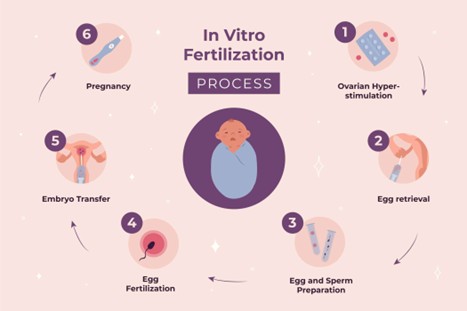
IVF or In Vitro Fertilization is a way to help women with PCOS get pregnant. At Nisha IVF we really focus on helping women with PCOS using IVF. This helps them have a baby. The process of IVF for women with PCOS is pretty straightforward. Nisha IVF uses IVF to help women with PCOS. When you choose IVF for PCOS at Nisha IVF here is what you can expect from the IVF process, for PCOS:
\

1. Personalized Consultation and Assessment:

The journey to have a baby starts when you talk to one of our fertility doctors. They look at your health records do some tests and talk to you about the problems you are having with getting pregnant. This information helps us make a plan for you to get the best results, from your IVF treatment. We do this because every person is different and we want to give you the chance of getting pregnant with IVF treatment.
\

2. Ovarian Stimulation:

One of the key challenges with PCOS is irregular ovulation. To overcome this, IVF treatment involves stimulating the ovaries with fertility medications to produce multiple eggs. At Nisha IVF they have good ways of doing this and they use medicines that are watched very closely. This is done so that your ovaries can make eggs safely and the eggs can develop in a way. The people, at Nisha IVF want to make sure that the ovaries are stimulated safely and that the eggs develop optimally at Nisha IVF.
\

3. Monitoring and Controlling Ovulation:

Women with PCOS have issues and that can cause problems. The ovaries of women with PCOS can get too excited when they are stimulated. At Nisha IVF they keep an eye on the follicles, which are like sacs that hold the eggs by doing ultrasound scans and checking hormone levels. They do this to make sure women with PCOS do not get something called hyperstimulation syndrome, which is a big problem. They also want to make sure they can get many mature eggs as possible from women, with PCOS.
\

4. Egg Retrieval:

When your eggs are ready the doctor does an operation to get the eggs from your ovaries. They give you sedation so you do not feel anything. You are comfortable. Then they carefully take out the eggs. Get them ready for fertilization with the sperm, in the lab. The eggs are collected carefully for this step.
\

5. Fertilization and Embryo Culture:

After they get the eggs the eggs are mixed with sperm in a room. Sometimes when the man has trouble making babies the doctors can use a way called ICSI to put one sperm into each egg. The eggs that have sperm are then kept in a place, for a few days and the doctors watch them closely to see how they are doing. The doctors pick the baby eggs to put into the woman’s uterus.
\

6. Embryo Transfer:

The final step in IVF is the embryo transfer, where one or more healthy embryos are placed in the uterus. This is a quick and simple procedure that doesn’t require anesthesia. At Nisha IVF, we prioritize transferring the best-quality embryos to increase your chances of successful implantation.
\

7. Pregnancy Test and Follow-Up:

After the embryo transfer, you’ll wait for about 10–14 days before undergoing a blood test to confirm if you’re pregnant. We provide continuous support throughout this waiting period, and if successful, we monitor your pregnancy with ultrasounds and blood tests to ensure a healthy progression.

Why IVF at Nisha IVF is Ideal for Women with PCOS
At Nisha IVF, we offer personalized, state-of-the-art treatments specifically designed for women with PCOS. Here are a few reasons why our clinic stands out when it comes to IVF treatment for PCOS:
\

1. Expert Care from Experienced Specialists:

Our fertility specialists are experienced in treating women with PCOS. We understand how PCOS affects fertility and offer treatments specifically designed to address its challenges. From the initial consultation to post-treatment care, we provide comprehensive support throughout the IVF process.
\

2. Advanced IVF Technologies:

Nisha IVF is equipped with cutting-edge IVF technology, ensuring the highest success rates. Our well-equipped laboratories and advanced embryo culture techniques give us the tools to optimize embryo selection and improve the chances of a successful pregnancy.
\

3. Minimizing Risks:

Women with PCOS can be at higher risk for ovarian hyperstimulation syndrome (OHSS). At Nisha IVF, we take special care to prevent this by closely monitoring your response to medications and adjusting treatment as necessary to ensure your safety.
\

4. Holistic Approach:

At Nisha IVF, we believe that the emotional and psychological aspects of fertility treatment are just as important as the physical. We offer counseling services to help manage the stress that often accompanies fertility challenges, ensuring that you feel supported throughout your journey.
\

5. High Success Rates:

Thanks to our personalized approach and advanced technologies, Nisha IVF boasts excellent success rates for women with PCOS. Our experienced team works tirelessly to optimize your chances of a healthy pregnancy.

Success Stories at Nisha IVF

Over the years, many women with PCOS have found success with IVF at Nisha IVF. Whether it’s overcoming irregular ovulation, balancing hormones, or managing the stress of infertility, our patients have gone on to experience the joy of parenthood. The success stories from Nisha IVF are a testament to our commitment to providing the highest level of care and support to every patient.

Conclusion

IVF is a beacon of hope for women with PCOS who are struggling to conceive. At Nisha IVF, we specialize in providing personalized IVF treatment that addresses the unique challenges posed by PCOS. With advanced technology, expert care, and a supportive environment, we are dedicated to helping you achieve your dream of becoming a parent.

If you are dealing with infertility related to PCOS, consider scheduling a consultation with one of our fertility specialists today. We’ll work with you to create a treatment plan that fits your specific needs and increases your chances of success.

At Nisha IVF, we’re here to help guide you every step of the way on your fertility journey—because your dream of parenthood deserves every chance to become a reality.


Frequently Asked Questions

1. How does PCOS affect my chances of getting pregnant naturally?

PCOS can affect your chances of getting pregnant naturally due to irregular ovulation. Women with PCOS often experience infrequent or absent ovulation, which makes it harder to conceive. The hormonal imbalances associated with PCOS can also interfere with the normal function of the ovaries. However, with the right treatment, like IVF, many women with PCOS can successfully conceive.

2. Is IVF the best option for women with PCOS?

IVF can be a highly effective option for women with PCOS, especially when other fertility treatments like medication or intrauterine insemination (IUI) haven’t worked. IVF bypasses the issues related to ovulation and allows doctors to retrieve multiple eggs for fertilization, increasing the chances of successful conception. At Nisha IVF, we personalize each treatment plan to ensure that IVF is the right approach for your unique fertility situation.

3. Will I need medication for ovarian stimulation if I have PCOS?

Yes, ovarian stimulation is a key part of IVF for women with PCOS. Fertility medications like gonadotropins are used to stimulate the ovaries to produce multiple eggs. However, women with PCOS tend to respond more sensitively to ovarian stimulation, so careful monitoring is essential to avoid complications such as ovarian hyperstimulation syndrome (OHSS). At Nisha IVF, we closely monitor your response to medications and adjust treatment accordingly to ensure a safe and effective process.

4. What are the risks of IVF for women with PCOS?

One of the main risks for women with PCOS undergoing IVF is ovarian hyperstimulation syndrome (OHSS), which occurs when the ovaries become overly stimulated and swollen. However, this risk is minimized through careful monitoring and adjusting of medication doses. Other potential risks include multiple pregnancies if more than one embryo is transferred. At Nisha IVF, we prioritize your health and safety and take every precaution to minimize risks throughout your treatment.

5. How long does the IVF process take for women with PCOS?

The IVF process typically takes around 4-6 weeks for a single cycle. This timeline includes ovarian stimulation, egg retrieval, fertilization, embryo culture, and embryo transfer. For women with PCOS, the process may take slightly longer due to the need for careful monitoring of hormone levels and follicle development. After the embryo transfer, there will be a waiting period of about 10–14 days before a pregnancy test is done. Your fertility specialist at Nisha IVF will provide you with a detailed timeline and guide you throughout the entire process.