
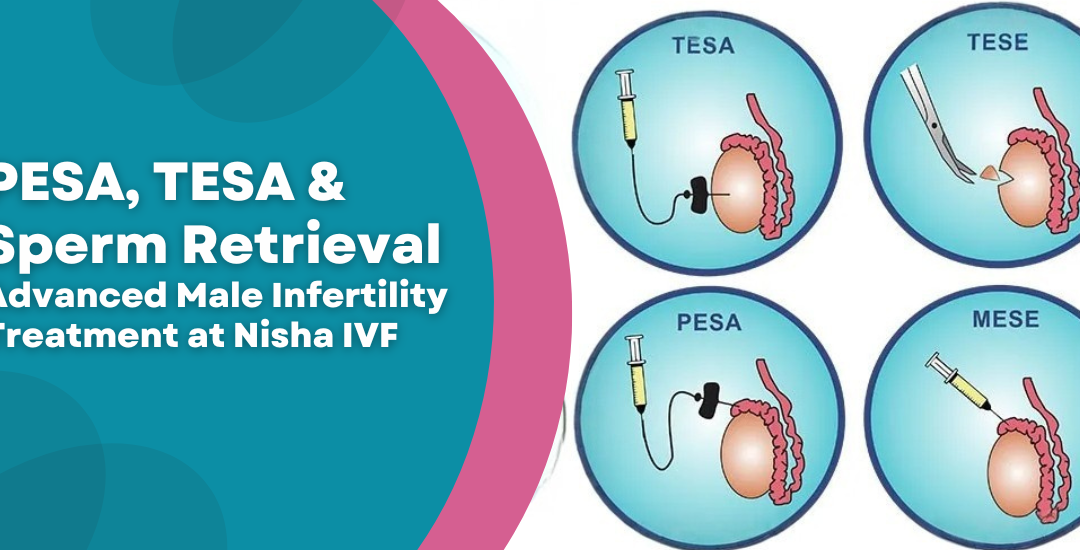
Infertility is often associated with women only, but it can equally be the result of male fertility issues. For many couples, male infertility can be a significant barrier to conception, but modern reproductive medicine offers various solutions to help men with low sperm count or sperm retrieval issues. PESA, TESA and sperm retrieval techniques have become essential tools in assisted reproductive technologies like IVF.
Nisha IVF realizes how much an emotional and physical burden male infertility can be. Couples facing such problems can still find relief and, most importantly, a solution through our state-of-the-art sperm retrieval procedure. This blog post will guide you through PESA (Percutaneous Epididymal Sperm Aspiration), TESA (Testicular Sperm Aspiration), and sperm retrieval, and how these techniques can serve men with fertility problems in their quest for a family.
Understanding Male Infertility and Sperm Retrieval
Male infertility is often linked to low sperm count, poor sperm quality, or blockages in the reproductive tract. In some cases, men may produce sperm but cannot ejaculate it, either due to physical blockages or other medical conditions. Such patients can avail themselves of sperm collection methods like PESA and TESA, where semen is removed directly from the epididymis or testes, respectively.
Nisha IVF delivers cutting-edge sperm retrieval techniques to reduce these barriers and finally allow couples to become new parents through the usage of reproductive technologies such as IVF or ICSI (Intracytoplasmic Sperm Injection), which are the most frequent ones.
What is PESA (Percutaneous Epididymal Sperm Aspiration)?
The PESA procedure is a way to get sperm from the epididymis. This is the tube at the back of the testes where sperm get ready and are kept. The PESA procedure is usually suggested for men who make sperm but have a block in the epididymis. This block stops sperm, from getting into the semen. The PESA procedure is a way to get around this block and get the sperm.
How PESA Works:
- Local Anesthesia: PESA is performed under local anesthesia to ensure the patient’s comfort.
- Needle Aspiration: A fine needle is inserted into the epididymis through the scrotum to aspirate (suck out) sperm. The sperm are then collected and processed for use in IVF or ICSI.
- Minimal Discomfort: As a minimally invasive procedure, PESA involves little to no pain, and the recovery time is usually short.
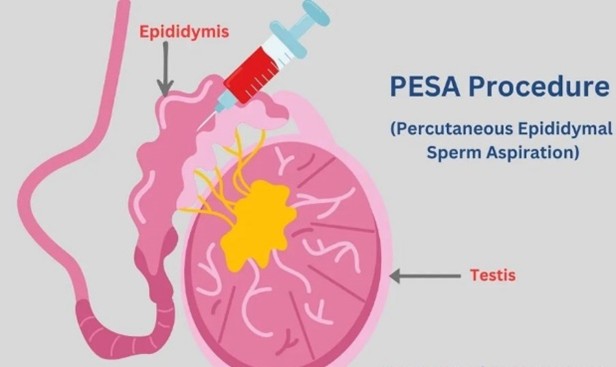
PESA is perfect for men who have a blockage or were born without the vas deferens, which’s the tube that carries sperm from the testes to the urethra but they still produce healthy sperm. The PESA procedure is really not that complicated. Men who have PESA can use the sperm they get from it for something called ICSI. With ICSI the doctor takes a sperm and puts it right into an egg, which helps the egg get fertilized. This way PESA and ICSI can really help men who have problems, with their vas deferens have a child.
What is TESA (Testicular Sperm Aspiration)?
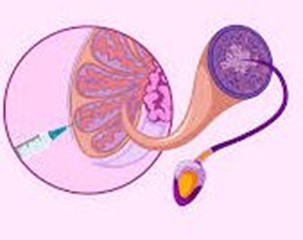
TESA is a way to get sperm from a man’s body. It is different from PESA because it takes sperm from the testes. The doctors usually suggest TESA for men who make sperm but have no sperm in the fluid they ejaculate. This can happen because of problems like azoospermia, which means there is no sperm in the semen. It can also happen because the testes are not working right or because of issues, with making sperm. TESA is a technique that helps these men by taking sperm from the testes.
How TESA Works:
- Local Anesthesia or Sedation: TESA is performed under local anesthesia, or in some cases, light sedation.
- Needle Aspiration: A needle is inserted directly into the testicle to aspirate sperm. The procedure is typically quick, and sperm are retrieved from the testes for use in IVF or ICSI.
- Post-Procedure Care: After the procedure, patients may experience some mild discomfort or swelling, but the recovery time is usually quick, and normal activities can be resumed shortly after.
TESA is really helpful for men who have a problem with making sperm, which is called -obstructive azoospermia. It is also good for men who have had a vasectomy or other surgeries that stop the sperm from coming out. The sperm that is retrieved through TESA can be used for treatments like IVF or ICSI. This can help men with TESA and their partners have a baby. TESA is an option, for these men because it can help them achieve a successful pregnancy with the help of TESA and these special treatments.
When Are PESA and TESA Recommended?
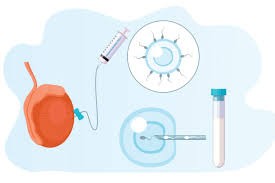
PESA and TESA are both used for men who have difficulties with sperm ejaculation or sperm count but still have viable sperm that can be retrieved for assisted reproductive procedures. Here are some of the situations when these sperm retrieval techniques may be recommended:
- Blockages in the Reproductive Tract: Blockages in the epididymis, vas deferens, or other parts of the male reproductive system can prevent sperm from reaching the ejaculate. PESA is ideal for retrieving sperm in these cases.
- Azoospermia: Men with azoospermia (lack of sperm in the semen) may still produce sperm in the testes, making TESA a suitable option for sperm retrieval.
- Post-Vasectomy: Men who have undergone a vasectomy and wish to reverse their infertility may opt for sperm retrieval techniques like PESA or TESA.
- Testicular Conditions: Men with conditions like testicular atrophy or varicocele may have impaired sperm production, and sperm retrieval can provide a pathway to achieving fatherhood.
- Congenital Absence of the Vas Deferens: Men with this condition, often seen in those with cystic fibrosis, can benefit from PESA for sperm retrieval.
Both PESA and TESA are particularly beneficial for couples where male infertility is a primary factor, and these techniques make it possible for men to participate in the IVF process, offering a chance to achieve a successful pregnancy.
Sperm Retrieval and IVF at Nisha IVF
At Nisha IVF, our goal is to help every couple achieve their dream of parenthood, no matter the fertility challenges they face. Through advanced sperm retrieval techniques like PESA and TESA, we help men with male infertility issues become fathers. These techniques are often combined with ICSI (Intracytoplasmic Sperm Injection), a procedure where a single sperm is directly injected into an egg for fertilization, increasing the chances of successful fertilization and pregnancy.
Once sperm is retrieved, it is carefully processed in our state-of-the-art laboratory, and the best quality sperm is selected for use in IVF or ICSI. This ensures the highest likelihood of successful fertilization and embryo development, maximizing the chances of pregnancy.
Benefits of Sperm Retrieval at Nisha IVF

- Advanced Technology: At Nisha IVF, we use the latest sperm retrieval technologies to ensure the best possible outcomes. Our state-of-the-art labs and skilled technicians handle every step of the sperm retrieval and fertilization process.
- Personalized Care: Every patient receives a customized treatment plan based on their unique fertility needs. Our experienced fertility specialists work closely with each couple to provide personalized support and guidance.
- High Success Rates: With PESA, TESA, and ICSI, many men with male infertility have successfully fathered children. Nisha IVF’s expert team is committed to achieving the highest success rates possible.
- Minimally Invasive Techniques: Both PESA and TESA are minimally invasive procedures that require only local anesthesia and have minimal recovery time, allowing patients to return to normal activities quickly.
Conclusion
Having trouble with fertility can be really tough for men. It is an emotional experience and there is hope. With techniques like PESA and TESA many men are able to have children. Nisha IVF is a place that helps men with fertility problems. They have ways to help men get the sperm they need. The people at Nisha IVF are very good at what they do. They take care of you. Support you every step of the way. Nisha IVF wants to help men become fathers. They know how much it means to men to have a child. So, they do everything they can to make it happen. Nisha IVF has lots of experience with PESA and TESA and other sperm retrieval techniques. They use these techniques to help men who are having trouble, with fertility.
If you or your partner is having problems with infertility issues you should think about making an appointment to talk to one of the fertility specialists at Nisha IVF. The fertility specialists, at Nisha IVF and you can work together to find the way to help you have a baby. Nisha IVF has ways to help you like getting sperm and using it for IVF to help you start a family or have more kids.
Contact us today to learn more about how we can assist you in your path to parenthood.